
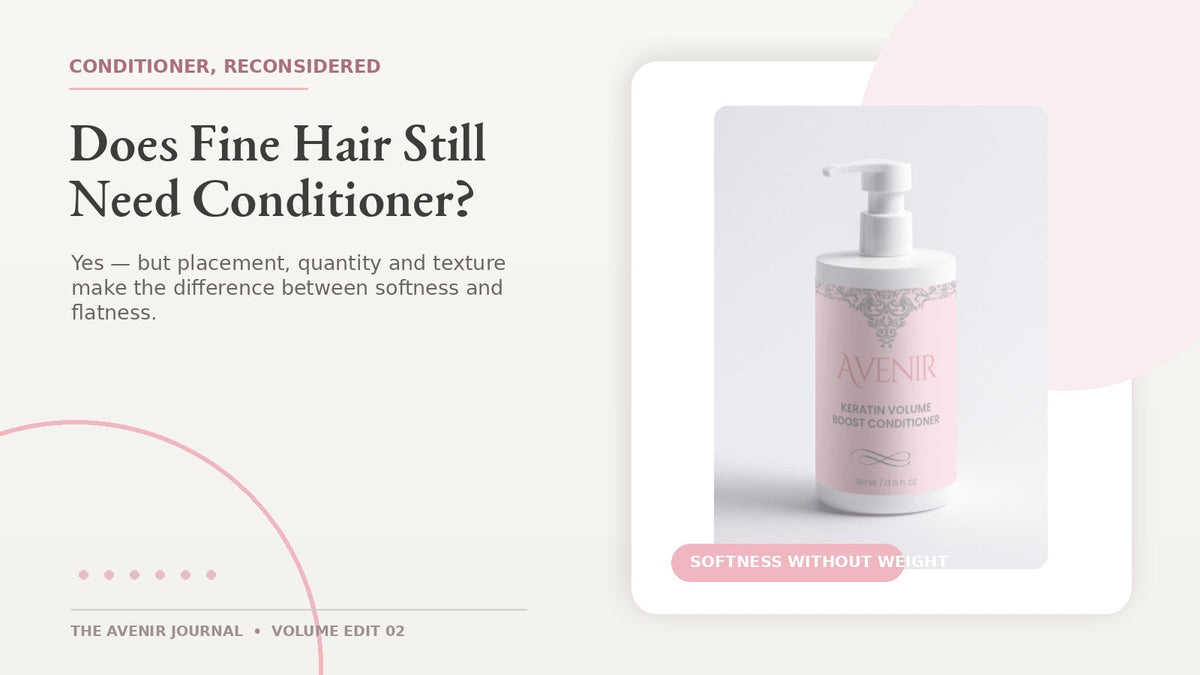
Fine hair is often given one blunt piece of advice: avoid conditioner because it will make your hair flat. That can sound logical when your roots lose lift easily, but it overlooks what the lengths and ends need.
Conditioner is not only about making hair feel rich or coated. It can improve slip, soften the surface and make detangling more comfortable. The issue for fine hair is usually not whether to condition, but where, how much and how thoroughly you rinse.
Why fine hair can still benefit from conditioner
Cleansed lengths may feel rougher without it
Shampoo is primarily used to remove oil, sweat, residue and environmental debris from the scalp and hair. After cleansing, the lengths may feel less smooth, especially if they are coloured, heat-styled, long or prone to tangling. A measured amount of conditioner can make the surface feel softer and easier to manage.
Better slip can support gentler detangling
When hair catches easily, brushing or combing can become more forceful than it needs to be. Conditioner provides slip, helping sections move past one another more easily. For fine hair, that benefit can be achieved without coating the roots.
Softness does not have to mean heaviness
A heavy result is often caused by quantity or placement. Applying a large amount from scalp to ends, leaving it on much longer than directed, or failing to rinse the underneath sections can all reduce movement. A smaller amount through the lengths can feel very different.
Where should conditioner go on fine hair?
Begin below the ears or around the mid-lengths, then work towards the ends. Use what remains on your hands to lightly skim any drier upper sections, but avoid pressing a full dose directly into the scalp unless the product is specifically designed for that purpose.
If your hair is very short, focus on the ends and outer surface rather than trying to avoid the root area completely. The principle is controlled distribution, not rigid rules.
How much conditioner should you use?
Start with less than you think you need. Emulsify it between your palms, then smooth it through wet lengths. If the product disappears before you reach the ends, add a little more. Hair length, density and condition matter more than following a single coin-size instruction.
Fine but dense hair may need more product than fine, low-density hair. Long highlighted hair may need more through the ends than a short, untreated style. Let the condition of the lengths guide the amount.
Signs you may be using too much
- Roots look flat soon after drying.
- Hair feels coated even though it has just been washed.
- Sections clump together instead of moving freely.
- You need to shampoo again sooner than expected.
- The hair feels slippery while dry rather than simply soft.
These signs do not mean conditioner is wrong for you. They usually suggest reducing the amount, moving it lower down the hair, or rinsing for longer.
Signs you may be using too little
- Ends feel rough immediately after washing.
- Hair tangles easily during drying.
- Static or flyaways become more noticeable.
- The lengths feel difficult to style despite clean roots.
An ingredient look at AVENIR Keratin Volume Boost Conditioner
The AVENIR Keratin Volume Boost Conditioner lists cetearyl alcohol and distearoylethyl dimonium chloride among its conditioning ingredients. Despite the word “alcohol”, cetearyl alcohol is a fatty alcohol commonly used in conditioners to support texture and softness; it is not the same as the volatile alcohols people often associate with dryness.
The formula also lists glycerin and sodium PCA, hydrolyzed keratin, vitamin E, caffeine, rosemary leaf oil, and coconut, avocado and sweet almond oils. For fine hair, the important practical step is to use this type of formula selectively through the lengths rather than assuming more will deliver a better result.
Always refer to the current ingredient list on the product page and packaging, particularly if you have allergies or sensitivities.
A two-minute conditioning method
- After shampooing, gently squeeze excess water from the lengths.
- Start with a modest amount and spread it across both palms.
- Apply from the mid-lengths to the ends, concentrating on the driest areas.
- Use fingers or a wide-tooth comb gently if additional distribution is needed.
- Leave for one to three minutes, following the product directions.
- Rinse carefully, especially around the back of the head and underneath sections.
Pairing conditioner with the right cleanse
A lightweight result begins before conditioner. Use the AVENIR Keratin Volume Boost Shampoo mainly at the scalp, rinse thoroughly, then use the conditioner only where the hair needs softness. This keeps the routine purposeful: cleansing at the roots, conditioning through the lengths.
Common questions
Can I condition fine hair every time I wash?
Many people can, provided the amount and placement suit their hair. If your lengths remain soft between washes, you may need less on some wash days. Adjust rather than applying the same amount automatically.
Should conditioner touch the scalp?
For a volume-focused routine, it is usually simpler to keep it off the scalp. If your scalp is dry, uncomfortable or persistently flaky, seek personalised advice rather than treating the issue by coating the roots with a standard conditioner.
Is a mask the same as conditioner?
No. A mask is generally a richer, more occasional treatment, while conditioner is the regular smoothing step after shampoo. Fine hair may use both, but not necessarily at every wash.
Softness and movement can coexist
Fine hair does not need to be left unconditioned to look fuller. A controlled application of AVENIR Keratin Volume Boost Conditioner through the mid-lengths and ends can support a softer, more manageable feel while preserving a lighter-looking root area.

Leave a comment
This site is protected by hCaptcha and the hCaptcha Privacy Policy and Terms of Service apply.